
Autumn lawn fertilization: this determines what your turf will look like in spring
Most garden owners think about the lawn in spring – yet the fate of the spring turf is actually decided in autumn. Autumn fertilization is the most underrated step of lawn care: it's not immediately spectacular, but it determines how the grass gets through the winter and how strongly it starts in April.
Why is autumn fertilizer different from spring fertilizer?
In spring and early summer the lawn asks for nitrogen – that's what green mass is built from. In autumn, however, nitrogen becomes the enemy: fresh, soft shoots don't survive the winter – they are frost-sensitive and prone to fungal diseases. The autumn formula therefore has to be potassium-heavy: potassium builds thick cell walls instead of thin ones, increases the “frost resistance” of the cell sap, and accumulates reserves in the roots – that's what the grass launches from in spring, weeks ahead of the neighbors.
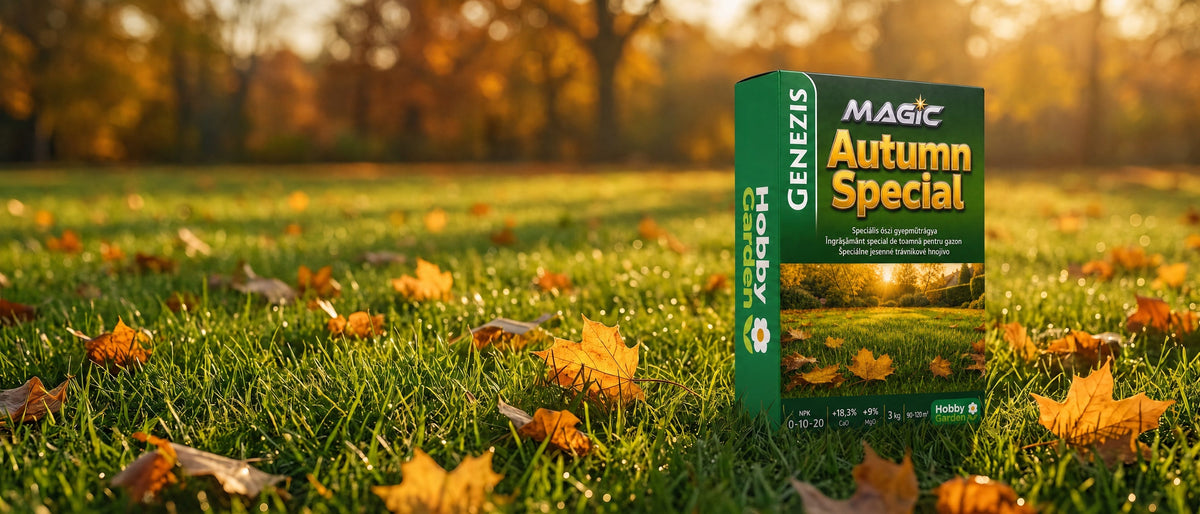
This is exactly what Genezis Special Autumn Lawn Fertilizer was made for: its potassium-heavy formula strengthens the tissues – you'll see the result not in November but in April.
When to apply it?
The ideal window runs from early September to the end of October, while the soil temperature is above 8–10 °C and the roots are still actively working. Spreading too early (in August) would still push growth; too late (end of November) it is no longer taken up – and never spread anything on frozen soil.
How to do it right
Mow the lawn to the usual height, spread the granules at the label's dose (when in doubt, the lower value), then water in thoroughly – that's the only way the active ingredients reach the root zone. If the autumn is dry, keep up the watering once a week for 1–2 weeks.
Autumn leaf raking also falls in this period: under a thick blanket of leaves left on the lawn, the grass molds – collect the leaves; it's just as important a winter protection as the potassium.
Why is it worth it? – next summer is also decided here
The effect of the autumn potassium treatment is threefold: less winter kill and snow mold, a stronger spring start weeks earlier, and – something few people know – better summer drought tolerance, because the deeper-grown, well-stocked roots reach more water. If your lawn burnt out this summer, the 30-day recovery plan + the autumn potassium together will make sure it doesn't happen again next year.
You'll find the full annual rhythm – what the lawn gets from spring to winter – in the lawn fertilization calendar. And for the autumn foundation of garden perennials, shrubs, and fruit trees, there's Genezis NPK 8-15-15 – the same principle: strong roots, frost-hardy plants, a strong spring start.